ENGR 122 · January – May 2025
Autonomous Racing Boat
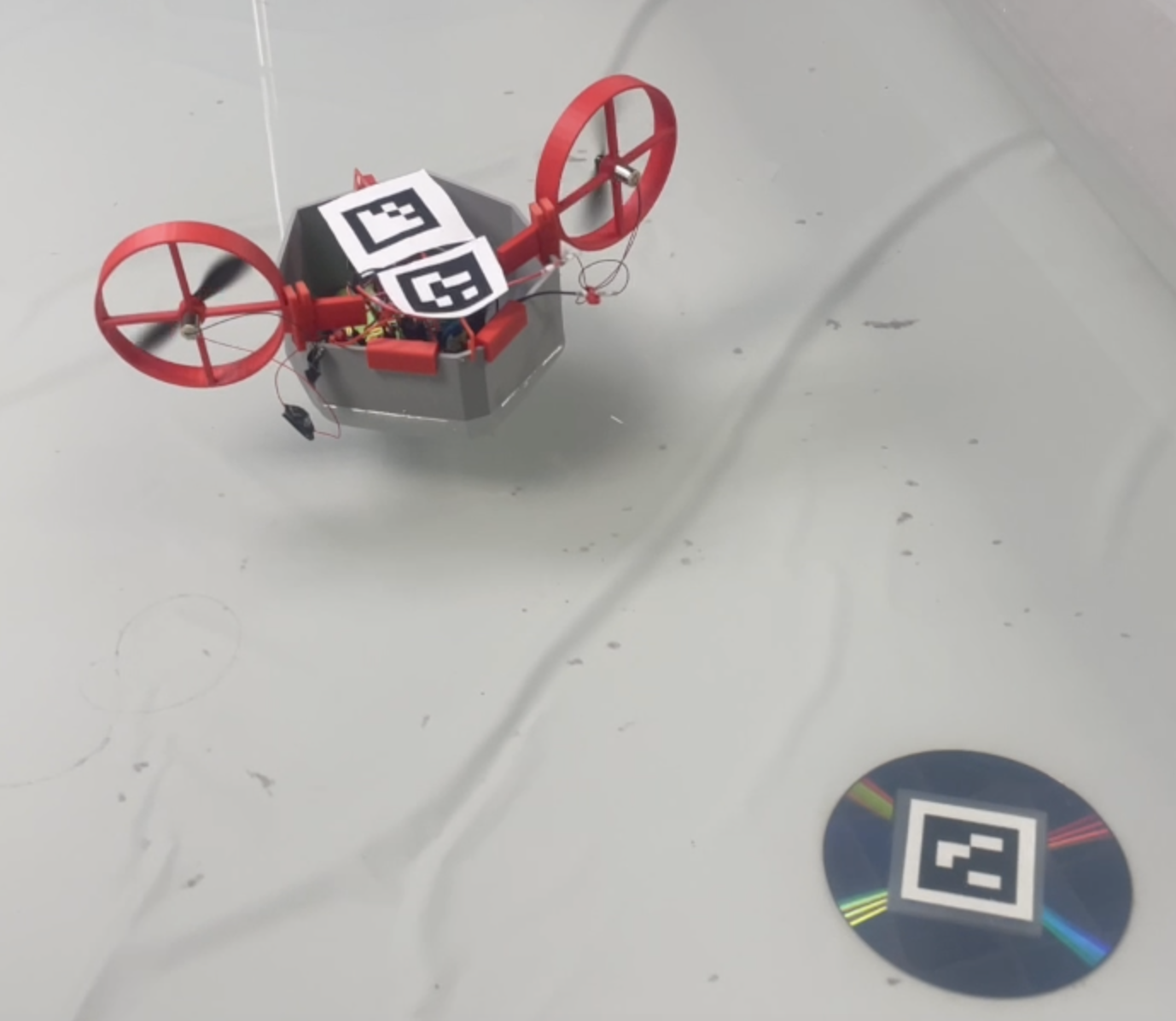
Project Overview
The Autonomous Racing Boat was developed as part of the ENGR 122 design course at Stevens Institute of Technology. The objective was to design and fabricate a 3D-printed, fully autonomous racing boat capable of completing three laps around a smart pool in under five minutes. The build spanned CAD, embedded electronics, and control software.
Client & Challenge
The client, Stevens ENGR 122 Design Lab, required teams to use a standardized electronics kit to build an autonomous watercraft that could navigate independently using onboard sensors and ArUco marker tracking. The main design constraints were stability, watertight electronics packaging, and navigation accuracy, within the course timeline.
Design Process
Hull development was iterative. Multiple geometries were evaluated in SolidWorks for stability, center of mass, and buoyancy, then printed at scaled and full size to check flotation and electronics fit.
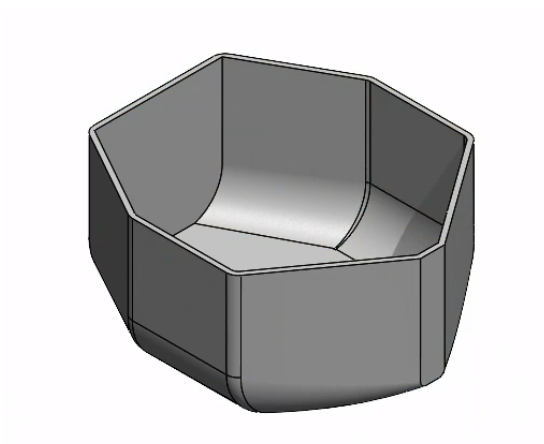
SolidWorks rendering of the Tortuga hull design.
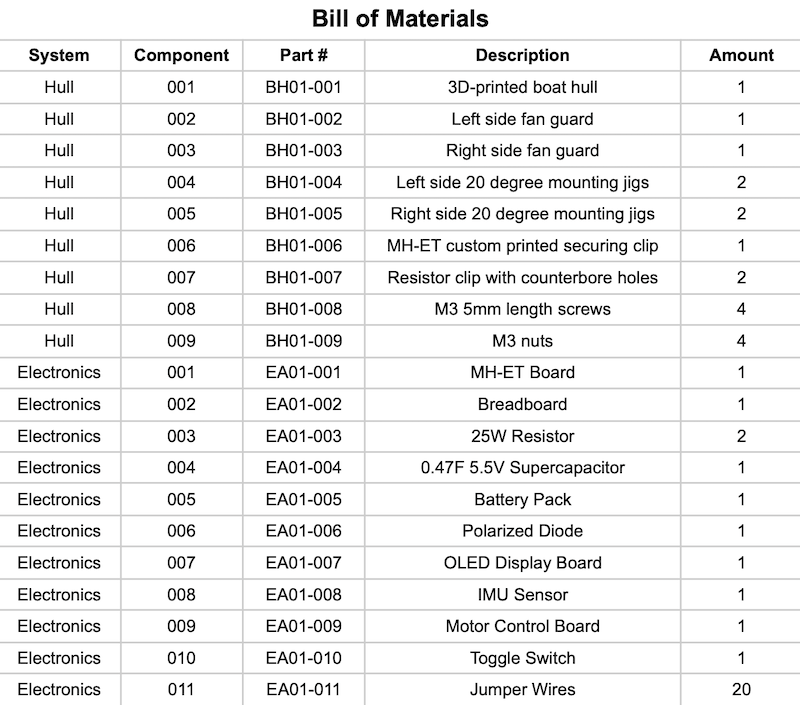
Bill of materials for the final boat design.
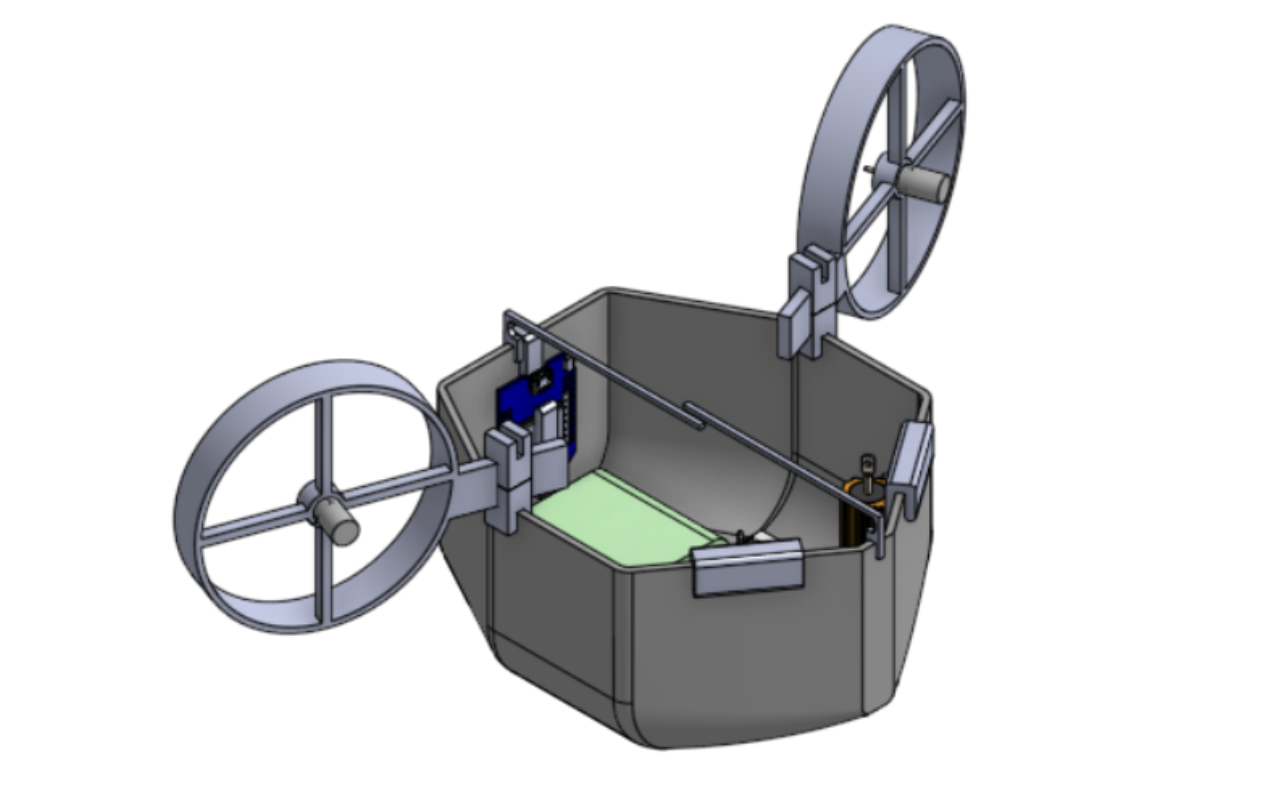
SolidWorks rendering of the complete boat assembly.
- Hull Design: Wide, turtle-shell-like base to improve stability and displacement.
- Fan Propulsion: Dual-motor configuration using angled fans for turning control.
- Component Mounts: Modular 3D-printed clips for easy installation and maintenance.
- Electronics Integration: MH-ET board with IMU, OLED display, and motor controller on a breadboard for modular wiring.
System Architecture
The autonomous system used an ESP32-based MH-ET controller communicating with Stevens' MQTT server to process ArUco marker data. The control algorithm used positional feedback to navigate between set waypoints and complete a loop around the pool.
- Inputs: ArUco marker positions, IMU orientation, user-defined waypoints.
- Processing: Position calculation, PID-based direction control, MQTT communication.
- Outputs: Dual fan actuation for navigation, OLED display feedback.
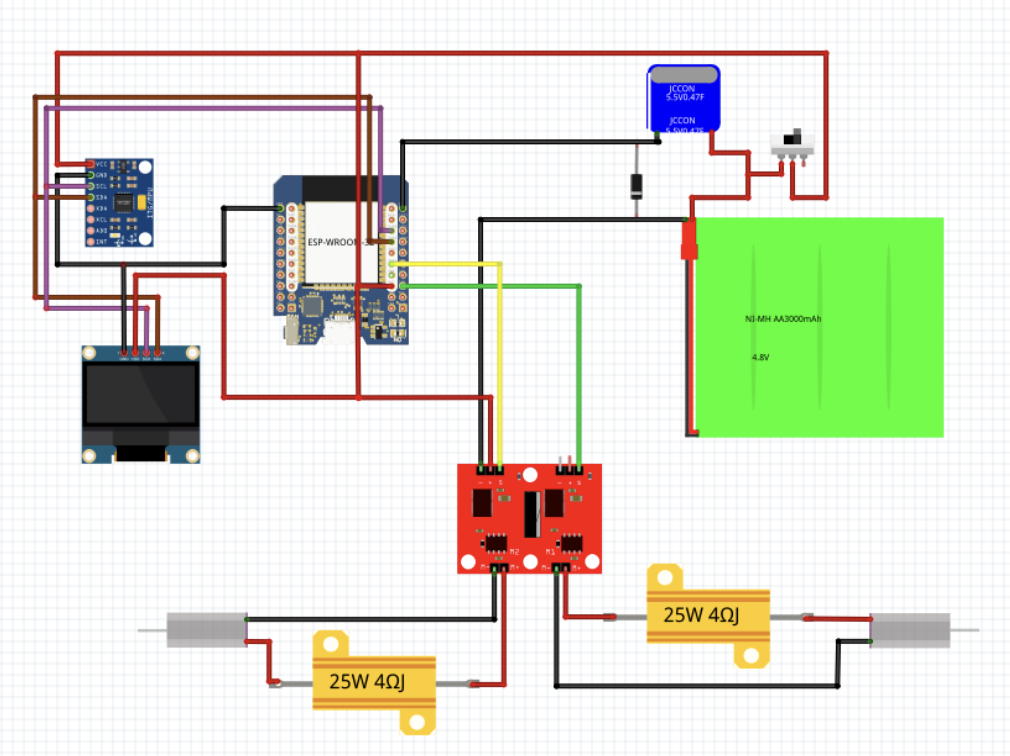
Circuit diagram depicting arrangements of sensors and actuators.
Programming & Control
The control logic implemented real-time position feedback and adaptive motor actuation. The navigation algorithm processed ArUco marker data to calculate distance and orientation relative to targets, then adjusted fan speeds to match.
- Read live position and orientation from MQTT feed.
- Calculate target direction and distance using trigonometric relations.
- Adjust fan speeds to align with the next waypoint.
- Advance through four preset corner targets to complete a lap.
Results
The final prototype achieved 2.5 laps in 5 minutes, short of the 3-lap benchmark. Waypoint tracking remained accurate across runs, fan actuation was consistent, and live telemetry streamed to the cloud throughout testing.
- Freeboard Height: ~2 inches with full electronics installed.
- Weight Capacity: 230g payload including battery pack.
- Lap Completion: 2.5 laps / 5 minutes.
- System Reliability: Stable operation across multiple test sessions.